Hammer & Co Est. 1897 · New York

Est. 1897

A house, not a marketplace

A marketplace connects two strangers and takes a fee. A house takes a view — on what a thing is, what condition it is in, and what it is worth — and puts its name to it.

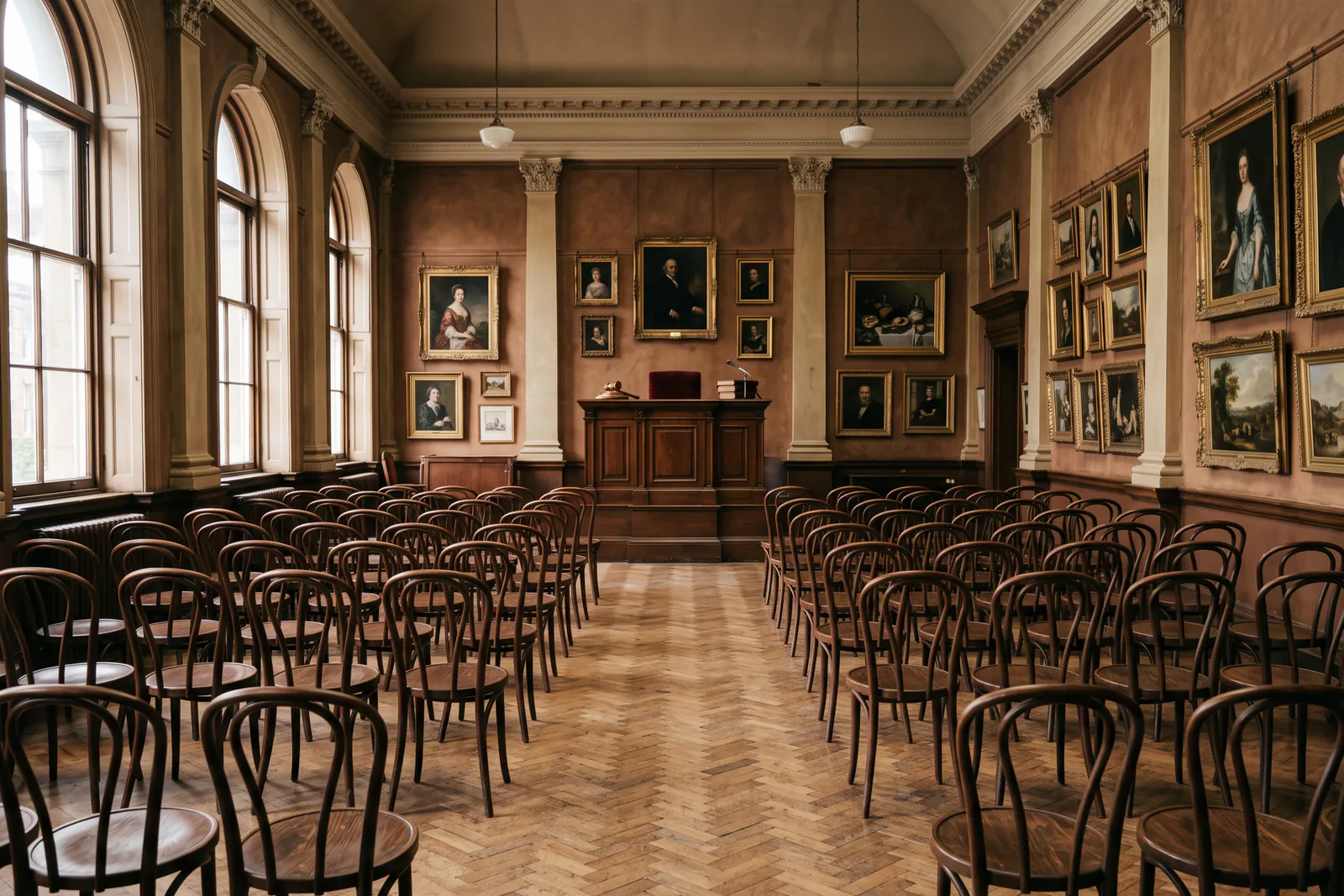
Rows of bentwood chairs on parquet facing a raised rostrum, paintings hung salon-style behind.
Founded
1897
Departments
10
Lots on the books
46
Sales in the cycle
7

How the house works

Four things we will not trade away

  1. 01

    Say what you know, and mark what you do not

    An attribution is offered at the strength the evidence bears. "School of" is not a euphemism for "we did not look"; it is a statement about how far the evidence goes. Where the department has an opinion it cannot support in print, it keeps it in the file and says so.

  2. 02

    Print the whole price

    The hammer price is not the price. Every lot page here shows the buyer's premium worked out in full, tier by tier, and the true total. Nobody should learn what a thing costs from an invoice.

  3. 03

    Publish the failures

    Every settled lot is published, including the ones that passed. A sold-rate is only meaningful if the denominator is honest.

  4. 04

    Decline more than you accept

    Particularly in antiquities, where nothing is offered without a documented history predating 1970. A house is defined by what it turns away.

The record

A hundred and twenty-nine years on one street

  1. 1897

    A room on Lafayette Street

    Josiah Hammer, a clerk who had spent eleven years cataloguing other people's libraries, took a lease on a single room and sold 214 lots of books in one afternoon. The ledger for that sale is still in the house and the handwriting is very small.

  2. 1923

    The first picture sale

    Books gave way to pictures, then to furniture, then to everything. The house learned the lesson it has kept: a department is not a category on a form, it is a person who has handled ten thousand of the thing.

  3. 1961

    The condition report

    Hammer & Co began issuing written condition reports as a matter of course, at a time when most houses gave them only on request and grudgingly. It cost the house money in the first two seasons and has paid for itself every season since.

  4. 1994

    Publishing the passed lots

    The house started publishing every result, including the lots that did not sell. Several competitors were briefly annoyed. It remains the policy: a house that publishes only its successes is publishing an advertisement.

  5. 2019

    Timed online sales

    Introduced with an anti-sniping rule from the first sale, because a saleroom that lets a lot be won on connection latency has stopped being a saleroom.

  6. Today

    Ten departments, one standard

    10 departments, 46 lots on the books at any one time, and 7 sales in the current cycle. The standard has not moved: state an attribution at the strength the evidence bears, describe a restoration as a restoration, and print what a thing actually costs.

The specialists

Whose name is on the entry

Every catalogue entry is written by a person and signed by a department. If you disagree with one, that is who you argue with.

Come to a viewing

Monday to Friday, 9.30 to 5.30. Saturday viewing days 10.00 to 4.00. Viewing days are free and open to anyone.